Showing posts with label Spanish Bilingual Education. Show all posts

Saturday, June 21, 2014

Graphic novel on Chernobil tragedy: Chernóbil - La Zona

On April 26th 1986 the 4th reactor at the Chernobyl nuclear plant exploded. I was at university at the time and still recall the TV images, the lack of clear information and the discussions about the effects on the explosion. We soon learned  that it was the worst nuclear catastrophe in history and the amount of radioactivity released into the atmosphere was equivalent of hundreds of Hiroshima bombs. 

The effects of this massive radioactive release reached locations over 2000 km away but the worst part was for the citizens of Pripyat, the city where most of the workers in the power station lived. They were exposed to extreme radiation for days until the Soviet authorities finally decided to intervene. Originally these were precautionary measures which involved removing the residents for a few days; however, they will later be told they can never return again. As a result of the radiation exposure, many workers involved in the cleaning of the area died. The cancer rate increased exponentially - thousands of children were born with malformations and a huge piece of territory in Ukraine, Belarus and western Russia is still unable to grow vegetables for human consumption.

The consequences of the radiation will be present in this area for hundreds if not thousands of years. However, the local authorities have opened the doors to controlled tourist visits in the hope that this will bring money and opportunities for the now almost empty area.


Francisco Sánchez and Natacha Bustos published a graphic novel in 2011 that tells us the story of what happened back in 1986 from the point of view of the people directly affected by the tragedy, the people working in the nuclear power station and their families in Pripyat. 

Francisco Sánchez visited an exhibition about the catastrophe in 2006 in Barcelona and he was impressed by the experience. The topic almost became an obsession for him and he spent years researching about the causes and effects of the event. He wanted to see and portray how the catastrophe has broken the lives and dreams of many people and their children. In 2009 he visited the area to gather graphic material and learn about the actual situation after almost 25 years. The graphic material would be used by the drawer to show the atmosphere of a soviet city very accurately in the novel.

Most of the previous information was taken from the following website.

The publication of the graphic novel in 2011, 25 years after the catastrophe, coincided  in time with the accident in Fukushima, something both authors commented in the presentation of their novel. And again, not all the information about what happened in Japan has been released to the public.


The graphic novel can definitely be used in a bilingual or IB program. It is linguistically attractive and deals with many topics that are relevant to the program of studies and our students' lives. Students will definitely enjoy researching and commenting about most of the topics in the novel:
  • What are the roles of governments in a crisis?
  • Can international help be a solution in a crisis?
  • To what extent should individuals be able to exercise their freedom of speech to access information during a crisis? 
  • How can we harness energy while minimalizing negatives effects on nature?
  • Which people are most vulnerable during a crisis?
  • How can we apply what we've learned to deal with future problems?
  • How the catastrophe has affected nuclear programs in Canada and all over the world? 

We can get more information about Chernobyl and its terrible effects on the website of Greenpeace Mexico.

"La noche temática" is a program on the Spanish TV which usually analyses controversial issues from several points of view. A documentary or film that deals with the chosen topic is also shown in the program. Over 25 years after the catastrophe in Chernobyl the topic was 'Alarma nuclear' in which the French documentary "Déchets, le cauchemar du nucléaire", was shown. Unfortunately, many years after Chernobyl things are far from being solved. You can watch the documentary in Spanish in this link. I could not find an English version but there is a German version with English subtitles available.


I highly recommend this graphic novel to work with our students in Spanish. It depicts the tragedy in Chernobyl from the point of view of the people who suffered the most. It can be a great starting point to start a research project with our students.

Wednesday, May 21, 2014

Two autobiographical graphic novels for the Spanish class

I'd like two introduce two graphic novels that have two of the features that I have considered important in previous posts: they portray personal stories and deal with controversial issues that can lead to discussions and research in our classes. The authors, Cristina Durán and Miguel Ángel Giner, are a couple of artists from Valencia, Spain. They have produced numerous artworks since 1993 in fields such as text books illustration, publicity, comics, etc. at their own art studio.

In 2009 they published their first autobiographical graphic novel, Una posiblidad entre mil (A chance out a thousand). Cristina and Miguel Angel have their first child, Laia, but her life is at risk starting when she was born due to health issues. Their daily routine consists of visiting hospitals, rehabilitation units and doctors. There is only one chance in a thousand for the baby to survive and she fights to grasp it with all her strength, affecting everyone around her with her zest and optimism for life.

The novel follows the authors' physical and emotional trip until Laia starts to go to school. We witness their devastation when they have to assume Laia´s condition that will affect her for the rest of her life. But we also witness their determination to shower their child with love and care through this often harsh journey.


Some  of the the discussion themes in the novel are:
  • Parenthood
  • The integration of handicapped children and the acceptance of the differences
  • The role of family and society
  • The importance of determination to achieve our dreams
La Máquina de Efrén, published in 2012, is the continuation to Una posibilidad entre mil. The graphic novel continues the journey initiated after Laia's birth. Cristina and Miguel Ángel always wanted to have one more member in the family, an adopted child. Both authors tell us the process of getting an adopted girl from Ethiopia. We experience their excitement, their anguish through all the bureaucratic process and the joy of achieving their goal of having one more child in the family. We also witness their trip to an unknown country for them, Ethiopia, and share their respect for a country full of problems but full of dignity too.


As in Una posibilidad entre mil, there are numerous topics to discuss with our students:
  • Parenthood
  • Responsibility
  • Adoption
  • First world versus third world
  • Multiculturalism
  • The right of everyone to happiness

Our students will definitely enjoy following Cristina and Miguel Angel's emotional journey through parenthood, compromise and commitment to their family and values. They will get attached to the characters and will realize about the importance of learning to respect the differences and being able to accept everyone. 

The authors talk about their work together and about adoption in La máquina de Efrén.
The graphic novels' website.
The authors' study website.
Pillada por ti, a free online comic on violence against women by the same authors.
Article in newspaper El Mundo on Una posibilidad entre mil.
First pages La máquina de Efrén
First pages Una posibilidad entre mil

Wednesday, May 14, 2014

Short stories by Gabriel García Márquez for

On April 17 Gabriel Garcia Márquez died in Mexico city. Little is left to be said about one of the most influential writers of the 20th century and, more importantly, one of the most read and beloved worldwide.

Naturally, the best we can do with a writer is to read and to enjoy his or her stories. And García Márquez was a master storyteller. He used the power of imagination to write his  realistic yet magical stories. He also could go deep into people´s hearts and show all the power and contradictions of people´s souls. Furthermore, he was a master of the language rivalling that of Borges. 

I am aware of the difficulty of reading a full novel like A Hundred Years of Solitude in Spanish in a secondary school. Luckily for us, García Márquez wrote several novellas, that we could use, and many short stories which students in an IB or bilingual Spanish program can fully understand and enjoy. His first short story, La tercera resignación, was published in 1947 and the author continued writing short stories for almost his entire life.

I'd like to introduce 5 of his short stories, although I am sure that many others can be used.

In the book Doce cuentos peregrinos, short stories Espantos de agosto and Me alquilo para soñar
I recall Garcia Marquez explaining what magic realism is in a interview on television. He mentioned that if we say: "vi un burro volando", nobody would ever believe us. However when we can give many details about a magical or unrealistic situation, everyone would believe us no matter how absurd it is. In the interview he said that if he wrote in a novel "vi 276 burros volando", everyone would believe him. Something similar happens in the short story, Espantos de agosto. The main character visits his friend´s house in Tuscany with his family. The old house was built by a member of the nobility during the Renaissance and it is haunted. As a reader I was not impressed. But when the narrator tells us how they visit the 85 bedrooms in the house, I started to believe that such a house must have at least one ghost and probably more.


Me alquilo para soñar
Garcia Marquez also mixes detailed reality with real-life characters with his magical and ironic world in this story. A lady who has been able to foretell the future of her family since childhood is hired by a rich family in Vienna. She was asked to tell them their fortunes through interpreting her dreams. Garcia Marquez meets her in Vienna and she warns the author to leave the city because he was in danger. When her boss dies years later she moves to a house in Portugal from where she can see the whole sea up to the Americas. Then she will meet Garcia Marquez in Spain during Neruda's visit and we realize that her powers are still intact.

Book, Los funerales de la Mamá Grande, Un día de estos
Garcia Marquez liked to portray Latinoamerica as a land where the supernatural is intertwined with every day reality at all levels. But he was also very critical with the social and political situation of his country, Colombia, and by extension of all Latinoamerica. This short story is a good example to explore this with our students.

Book, La increíble y triste historia de la cándida Eréndira y de su abuela desalmada, the short story Un señor muy viejo con unas alas enormes.
This short story is another good example of magic realism. The fate and luck of a poor Colombian family changes when they find an old angel after a storm and take him home. The angel becomes a celebrity and people "from all over the world" come to see him. Things get so complicated that even the local priest has to intervene. After many years living in very poor conditions, the strange angel flies away and the family is relieved.

Ladrón de sábado
This is a beautiful story full of irony and humour. Hugo is a thief who only robs houses on the weekends. One weekend he robs Ana´s house, the conductor of his favourite music radio program when she is at home. He feels so comfortable that he decides to spend the weekend with Ana and her daughter, taking advantage that her husband is away on a business trip. Soon, his weekends will be busier than usual.


There are thousands of websites where we can get information about García Márquez' works, his life and his political opinions. I recommend to have a look at these three web sites:
  • El País newspaper published several articles about the author after his death, we can track his life and his works in this article
  • Interview to Chilean writer Isabel Allende, also after his death.
  • Conversation between the Nobel Prizes winners García Márquez and Vargas Llosa, which took place in 1967. They discuss about writing, magic realism, Latinoamerica, their literary influences and many other issues.

Tuesday, May 6, 2014

Online journals on biligualism, CLIL and language teaching

A very good way of learning about new developments in second language teaching is to regularly read online journals. Fortunately, most of them are either free or just require a reasonable fee for teachers and school districts. As I said, it is essential to keep updated in new developments and to learn about experiences in schools all over the world offering CLIL, bilingual and/or second language courses.

The online journals I (try to) follow regularly are the following. I have copied/pasted the excerpts of the aims for your information.

1. Porta Linguorum, Universidad de Granada.
Numbers published: 21 numbers so far. 
Aim: Porta Linguorum is an international inter university journal specialised in foreign language didactics. It aims to publish empirical studies, critical revisions, and theoretical models related to the factors that influence the teaching and learning process.
Free access.

Numbers published: 22
Aim: The goals of Encuentro are didactic and methodological training, together with the development of reflection and classroom research on the part of language teachers. These goals also govern the content of the journal: applied linguistics, language teaching and learning, the presentation of research and innovations, values and interculturality, literature teaching, and related matters.
Free access.

3. Latinamerican journal, Universidad de La Sabana.
Numbers published: 7
Aim: LACIL is a peer-reviewed journal focused on CLIL (Content and Language Integrated Learning), multilingualism, interculturalism, and Call, throughout Latin America and around the world.
Free access.

Numbers published: 76
Aim: The Asian EFL Journal is published monthly and presents information, theories, research, methods and materials related to language acquisition and language learning. 
Free access.

Numbers published: 7
Aim: The ICRJ is an electronic refereed journal which acts as a platform for researchers across the world who work on Content and Language Integrated Learning (CLIL). Research in this field is often published in a range of journals reflecting different disciplines. The ICRJ attempts to consolidate insights and research findings into a single publication so as to enhance accessibility to those in the field.
Free access.

6. CLIL journal.
Numbers published|: 4
Aim: to provide an easy accessible and high level resource of information for teachers working on or interested in working in CLIL programs.
Subscription required but the journal can be read online for free.
Free access.

Numbers published: 19
Aim: LFE invites submissions of original full-length articles, short articles and book reviews from scholars in the field of languages for specific and professional purposes. This includes areas of discourse analysis, pragmatics, sociology, contrastive analysis, global languages, development and implementation of specialized corpora and software, learning and teaching techniques and methodology, curriculum development, among others.

Numbers published: 18
Aim: The International Journal of Bilingualism (IJB) is an international forum for the dissemination of original research on the linguistic, psychological, http://www.todoele.net/jslt.htmlneurological, and social issues which emerge from language contact. While stressing interdisciplinary links, the focus of the Journal is on the language behaviour of the bi- and multilingual individual.
Subscription required.

Numbers published: 2
Aim: JICB aims at publishing research on language immersion and other types of content-based language education programmes that are subject matter-driven and subject matter-accountable. The journal provides a forum for research on well-established immersion and content-based programmes as well as research on new initiatives within the broad field of content-based language education.
Subscription required

Numbres published: first issue on June 2014
El objetivo principal de la publicación es crear un forro de debate para investigadores y profesores de español de todo el mundo que contribuya al desarrollo y enriquecimiento de un campo en constante crecimiento. En ella se recogerán trabajos teóricos e investigaciones sobre todo lo relacionado con el español como lengua extranjera.
Subscription required.


Wednesday, March 19, 2014

Los Surcos del Azar, a graphic novel for the Spanish class

I have been showcasing resources about the Spanish Civil War. It is a very interesting topic to work with our students because they are familiar with the historical events around that time in Europe. It is important that they are aware how these events are interrelated and the fact that the Spanish Civil War cannot be understood outside the rise of totalitarianism in European countries.

I also like graphic novels for many reasons. They can help students to get used to reading in a second language and enjoy it. Another important reason is because authors tell us personal experiences which students can relate to easily. There has been a great production of graphic novels in Spanish speaking countries in the last years and we can use them in our Spanish classes.

Paco Roca is one of my favourite authors. I have introduced his award winning graphic novel Arrugas, which I highly recommend . Today I'd like to talk about his latest work, Los surcos del azar , which explores the lives of Republican soldiers after the Spanish Civil War and their involvement in the Second World War.  It is not the first time that Paco Roca uses the Spanish Civil or post-war as the  setting  one of his stories. In El Faro we read the story of Francisco, a young republican soldier. He became involved in the war by being conscripted like many other young Spaniards. After the war he flees and meets Telmo, an old lighthouse keeper who lives his life freely. Telmo will guide Francisco to a world of adventure and discovery until Francisco finally finds his place in the world away from his traumatic experience in the war.


Paco Roca was also the artist in El Angel de la Retirada published in French with a storyboard by French writer Serguei Dounovetz. More information in a previous entry.

Los Surcos del Azar was published in 2013. It is probably his most ambitious work up to now and  again depicts the lives and fates of the Republican soldiers who had to leave Spain after Franco´s victory in 1939. The title is taken from a poem by Spanish poet, Antonio Machado in his book Campos de Castilla (Proverbios y Cantares II):
¿Para qué llaman caminos
a los surcos del azar?...
Todo el que camina anda,
como Jesús, sobre el mar.

Antonio Machado had to leave Spain in 1939 entering France on foot accompanied by his ancient mother with the rest of refugees. This scene is portrayed in the novel as a token of the helplessness of the situation for the refugees. The poet and his mother died a month later in the small town of Collioure, which has become a place for pilgrimage.

In this article Paco Roca explains how he started the project after meeting Manuel Fernandez and Luis Royo in Paris in 2008 during the presentation of La Nueve, los españoles que liberaron Paris by Evelyn Mesquida. They were two of the few survivors of the company and Paco Roca found the story fascinating. Probably, we would have seen many films about their lives, had they been from a different country. 

The author started to research about these historical facts and found Miguel Campos, another member of La Nueve who disappeared mysteriously just after the liberation of Paris. The novel follows Miguel Campo´s life through his conversations with the author,  like a documentary and 70 years after everything happened. We learn that he is one of 1,800 lucky ones who could board the ship Stanbrook in Alicante port in 1939, where over 15,000 people where waiting for other ships which never came. Then we follow his steps in Oran, Algeria and how the French authorities put them in concentration camps to build the never completed Sahara railways.

With many other exiled Spanish he takes part in the Tunisia campaign against General Rommel and then the group of Spanish republicans joined Leclerc's army to form La Nueve company. The company is taken to England for training and after the D-Day they start their trip to Paris taking part in uncountable battles. When the French leader de Gaulle learns that a revolt has broken up in Paris against the Nazis, he asks the alleys to attack Paris. It is August 1944 and the Americans are not willing to enter the French capital out of fear of the reprisals on the civil population by the Nazis authorities. However, de Gaulle insists and orders Leclerc to enter Paris. La Nueve company, like in many other French cities before, is the one leading the attack reaching Paris city hall on August 24, 1944. The German garrison surrenders the day after (source Wikipedia). The bulk of the Alley troops parade in Paris on the 26th.

Most of the members in La Nueve company have been fighting since 1936, and some will still participate in the battle of Strasbourg and will eventually reach Hitler´s Eagle Nest. However, the main character Miguel decides to abandon the war to head back to Spain with his partner to fight Franco. When his partner dies in a car accident on the way to Spain he decides not to fight any more, settling in France and mourn his dead partner and also his lost country. 

Paco Roca convinced Miguel to talk about all these events 70 years later. He had kept silent for all this time and not even his closest friends knew anything of his struggle. He was a deserter after all! The graphic novel is presented in the form of a documentary. Paco Roca asks questions to Miguel and there are continuous flashbacks to the facts he is recalling. We also are present at the process of getting to know each other until Miguel trusts the author completely.


The real history of Miguel could be the plot for films or TV series however it was lost like the rest of the members in La Nueve. The graphic novel unveils the story of a group of people who lost a war and along with it their home and their country but who never gave up trying to liberate Europe. It is also the story of Miguel who also lost his family, his partner and was condemned to a life of silence. The story is told in a realistic way, like a documentary,  showing the injustice of wars and the cruelties committed by the contestants.

I highly recommend the graphic novel for an ADULT reader.

More information about Paco Roca's work in La guía del cómic.
Interview in RTVE.
Article in El Pais newspaper.
Paco Roca´s website
Post on La Nueve company
Conference by Evelyn Mesquida on Vimeo

Tuesday, March 4, 2014

Juegos Inocentes Juegos, a novel recently published for the Spanish class

One of the main goals for this blog is to showcase resources that can be used in Spanish bilingual or IB programs (not only novels, short stories or poems to work in class but also resources for independent and enjoyable reading in Spanish). Today I am going to talk about a short novel published in 2013 by Ricardo Gomez. Gomez visited Alberta in 2012 when I was in Spain so I was unable to attend  his school visits. However, it is an author I discovered some years ago and I have wanted to talk about in the blog for a long time.

Ricardo Gomez has written poems, books for adults and books of the so called "literatura infantil y juvenil", books, aimed at children and young adults. I know that numerous authors, including Gomez himself, disagree that such literary category exists. They believe that there are only good or not so good stories but the term can be useful to understand that we mean stories that young readers can find attractive. Ricardo Gomez is definitely a special case among writers because he portrays teenagers and their world in a very accurate and realistic way (not in vain he was a Math teacher in secondary schools in Spain until 2004). As he mentions on his website, he felt he was reborn after taking the decision of becoming a full time writer.

We can learn more about the author on his website. I particularly recommend to have a look at his conferences on mathematics issues that he has discussed in schools and universities. These are also  available online. The conferences deal with attractive topics like the relation between literature and maths or how to make maths more entertaining for students. There is also a section to raise awareness about the situation of the refugees in the Sahara desert. Of special interest is the Bubisher project which tries to support children´s education bringing them a mobile library to the refugee camps where they live.

There is also a reference to all of his books in his web, some for adults and some for children and teenagers, although the author says he wonders if there is a separation between both. I will talk in another post about some of the books which can be helpful for our bilingual programs: La Selva de los Números and Las Hijas de Tuga which tell us the story of the discovery of maths by Tuga, a very smart turtle. I will also speak about Ojo de Nube and Cuentos Crudos, which deal with issues which affect us all, and 3333 set in a not so distant technological future.


Juegos Inocentes Juegos was published in 2013 and won the XIII Alandar award for books for teenagers, given by Edelvives publisher. Sebastian, spelt without an accent as it is normally in Spanish, is seventeen and lives with his divorced mother. He goes to a high school, is not a good student and he keeps to himself at school. But Sebastian has a double life that makes him different from the rest of peers: he has been testing video games for a multinational company and getting a lot of money out of it.

We then learn about his monotonous life with his mother at home and at school but also all the problems his family went through. He doesn't have many friends and does not get along with teachers. It seems that his virtual life is more realistic and rewarding than his actual life. But the video games can hide something much more sinister. Sebastian is very good, cool and intuitive with the games. Little by little we learn that some of the prototypes that has been trying are drones (UAV, unmanned aerial vehicles) used to fight in wars. And soon, without Sebastian being aware, he will be participating in real battles killing real people in an unknown country far away. At the same time that this is happening Sebastian is becoming more sociable and meets Patricia, someone he is really attracted to. At the end we see all the damage caused to the small community far away by the drone attacks and how Sebastian was just part of a superpower's plan (readers slowly realize that the attacked location is Afghanistan).


It is not a book with a plot full of action, the rhythm is quite paused. We follow Sebastian´s story through the chapters, alternated with chapters where the life in the small community in Afghanistan is portrayed and the chapters in which military men are designing the new warfare. The book also brings up important topics like the fine line between reality and fiction, the power of the 'governments' over all of us, the growing difficulty of intimate personal communication, the growing pains teens experience, the lack of opportunities for the young generations in Europe and so on.

Another important reason why the book can be good reading for our students is the precise language used by the author which is very appropriate for second language learners. At the same time Ricardo Gómez knows the young people´s slang and he uses it in his books very accurately.

I highly recommend Juegos Inocentes Juegos for our students in a bilingual program though it is an equally interesting story for independent reading.

Monday, February 10, 2014

More sites for good books in eduPLEmooc

I'd like to continue showcasing websites and blogs which provide information and reviews about books that can be used in a Spanish bilingual or IB program in Alberta. I came across these three resources from the eduPLEmooc course that I am taking. 

Last week we started our group research projects. It was actually very difficult to narrow it down to one topic but eventually, I chose digital storytelling. The working group has over 30 members who come from several countries. They all work in different educational settings and thus, this makes group work more challenging and enriching at the same time. The reasons why I chose the group are these:
  • I want to learn about the  tools to create digital stories, something I have not had the opportunity to do before.
  • I am really interesting in sharing pedagogical approaches on how to better introduce storytelling in a classroom
  • I want to hear about other teachers' experiences, especially in second languages teaching and how they use storytelling to improve  the students' writing outcome.
As the course is a mooc, an open course,  we are also showcasing all of our projects to each other. I have been regularly reading what other groups have uploaded and I came across some very interesting links to get information and reviews about books for our Spanish bilingual or IB programs. These are trhe three resources I would like to share today.

A board in Pinterest kept by teacher, Toni Solano, who gives us lots of tips and suggestions for good books to use in a secondary school in Spain. I find it very intresting it because there are many references to books for young adults that can be useful for our classes and school libraries. The board is open and anyone is welcome to join and share.

Some of the educators who have been including suggestions in the Pinterest group also share a Google group about books and reading. It is open and the information that everyone supplies is also very interesting. A must-follow for all of us working with bilingual programs in Alberta.

Some of the many resources shared by the Google Group is the magazine La pagina escrita, published by the foundation Jordi Sierra i Fabra. I have already spoken about this foundation when I introduced the Jordi Sierra i Fabra awards for young writers. In the magazine there are interviews and conversations with writers, famous for their books for young adults, many of them have been already introduced in this blog. We can also find book reviews and reading suggestions. However, the section that includes short stories by young writers can be very useful for us as teachers. Every number includes 3 or 4 short stories plus around the same number of poems written by writers no older than 23. Because of the closeness in age, our students will no doubt find these stories very relevant to their lives. These may even inspire them to write Spanish stories of their own!

No. 6 (enero 2014)

eduPLEmooc has proved to be a great tool to learn form each other and share resources and information. I hope that we will have lots of interesting resources to share very soon about digital storytelling.

Sunday, October 20, 2013

El Arenque Rojo, a great tool for reading and writing in the Spanish Class


I had the pleasure of meeting Gonzalo Moure in 2009 when he was invited  to work with the Spanish bilingual schools in Calgary and Edmonton. Prior to his visit, students read and worked with some of his books to prepare for their exchange with Gonzalo. I was lucky to be present for most of his visits to schools and I have to say that he has the gift to spark students' curiosity and knows how  to communicate with them. I have worked in education for many years and I know how difficult it sometimes is to engage students in discussions and make them aware of realities far from their lives and Gonzalo is a master of this difficult art.

In one of  the classes there was an animated discussion about writing stories. Gonzalo told the students that he could write a story which contains love, passion, death and mystery with only 11 words: "la gacela pensó que el tigre era hermoso, un segundo antes". He was playing with the imagination of the reader who is going to build up a story suggested by only 11 words. To our astonishment, a young student said that she had created a short story which suggests so much with only 8 words: "Reina quería matar a Rico, pero le amaba". Now, when we work with "microrrelatos", flash fiction, I always give students these examples to prove how literature has the power of suggesting and making our imagination work.
 
Gonzalo has published over 30 books and has won numerous literary awards. Several of his books have also been recommended by the prestigious International Youth Library, The White Ravens. His books are written for children, teenagers and young adults who are and in many cases the main characters in his stories. I always say that it is not easy to write for children and teenagers because one has to write in an informative manner but in a way that the children would not feel like they are being patronized. Gonzalo is a master at achieving this.

I also find his books attractive since they deal with social or environmental issues. His love for nature and particularly horses is one of recurrent topics. He also has a passion to talk about his experiences with working with the refugees from the former Spanish colony in the Western Sahara, one of the harshest places in the world. He has committed himself to help the children in this community offering them access to books and reading with the project of the Bibliobus, a wandering library who takes books on an old bus to the refugee camps scattered in the desert.

There are many books that deserve to be blogged about and I will do it sooner than later. I just want to introduce El arenque rojo, published in 2012. The book has an attractive, original format and can be a beautiful tool to use in our classes.  The first striking thing is the fact that there is no text in the book. We follow the red herring in a park at different moments in a busy evening in Spain while we leaf through the pages. We follow El arenque rojo which is perhaps leading us to wrong conclusion  Around the herring, hundreds of stories are shown to us through the beautiful drawings by Alicia Varela, the illustrator. There are children playing, parents with kids, grand parents reading or passing through after shopping... even the author is watching everything while he rests on a bench. And there are as many stories as our imagination can tell. On the last page of the book, there is a surprise, an attached envelope with various of the stories happening in the park according to the author. But he invites us to write the rest or reinvent those already given.

I think the book can be a great resource to invite students to write or reinterpret stories. It will make it easy for students to realize about the power of imagination and how stories can be told in almost uncountable ways. A great tool to encourage students to enjoy reading and telling stories.

Gonzalo speaks about how the book was conceived and its goals in this post on his blog.

SM publisher introduces the book on its website where we can read some of the stories in the envelope and we are encouraged to publish our story in it.


I highly recommend El arenque rojo to work with our students. I also encourage schools to try to invite Gonzalo Moure to visit them. He is a master engaging students in all kinds of activities and I am sure during his visit students will enjoy an incredible experience.

Tuesday, October 1, 2013

30 second short films for the Spanish class

In this post, I'll continue my previous conversation about 30 second long short films that appear in the Notodofilmfest. We relate these films with "microrrelatos", flash fiction, of which we have so many good examples in Spanish. I am going to introduce some of these "flash short films" that deal with the impact of technology on our daily lives.

Flatmates 3.0 by Francesco Marisei. This first short has won numerous awards for its simple but powerful message. Only one shot is enough to tell us so much about the communication society we live in. It is full of irony and sadness and it can lead to enriching discussion in our classes.


In many ways related to the previous short film, I find Las Batallitas del Abuelo, by Néstor Fernandez, very interesting. A grandfather is telling his grandson about his "batallitas" in his younger years, when he was brave, idealistic and dreamt of changing the world. Only that when he was young, the Internet took over society and changed it forever. This short is very powerful but we need to consider the language used before showing in a class.


And technology has changed the way we get involved romantically with other people, as Chicaconocechico by Pablo Vara  depicts in 30 seconds full of irony.


These 3 short films can be used to discuss about how technology is affecting and changing our lives in the era of global communication. It doesn't mean that we feel less lonely though.

Wednesday, September 25, 2013

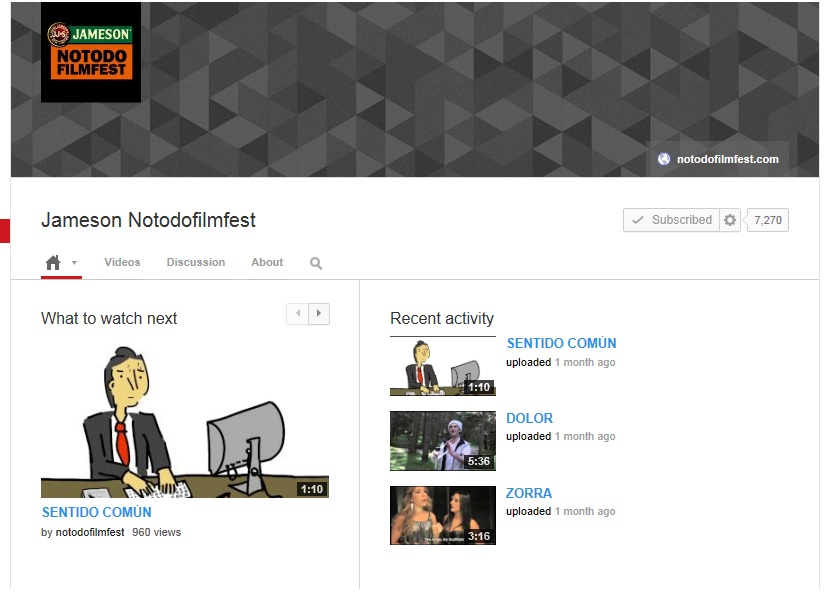
Notodo Filmnfest, short films for the Spanish class


I came across Notodo Filmfest surfing the web in the look of resources for the Spanish class. My first impression was not very optimistic, considering the main sponsor of the festival. However, after a closer look I was very much surprised and I highly recommend to spend some time surfing its website to find very interesting resources for our Spanish classes.


Some of the features I like about the festival and the philosophy behind are:

  • The short films can be in any language (most are in Spanish) and must have English or Spanish subtitles. We can encounter many cultural realities.
  • Short films cannot be longer than 3 minutes and a half. This fact makes them very flexible for a class.
  • The Jameson Triple Distillation Award is for 30 second long films, which makes their length similar to commercials and relate them to the concept of microrrelatos that I also like to use in my classes.
  • The jury members are recognized film directors or screen play writers, so the quality of the awarded films is guaranteed.
  • There is section called Latinoamerica en corto, so we have also access to a number of short films from other Spanish speaking countries, not only Spain.
  • There is section that includes three and a half minutes documentaries. They deal with current issues in a very accessible way.
Apart from the festival website, we can have access to the films in  the YouTube watching list:


There are several short films I would like to comment on but it will be on my next post.

Saturday, September 7, 2013

Resources to better understand the Middle Ages: the prose

Continuing the showcase of Middle Ages resources,  I´d like to introduce some works in prose.
 
El Conde Lucanor by Don Juan Manuel is one of the first works in Spanish in prose. The author was a nobleman involved in the political intrigues of his time. He fought in different campaigns and gained territory for his king, to whom he was directly related.

The book is a series of 50 short stories that follow the same pattern. A young nobleman, count Lucanor, introduces a problem or worry to his servant Patronio. Patronio, who is a man of his time, apologizes humbly to his master because he is just a poor servant but tells him a story that is related to the proposed problem and offers a solution to it. Lucanor, of course, ends up following the "advice" from these stories. The morals of the stories also appear in a short verse at the end of the story.

Most of the stories come from known sources: classic or Arabic authors, folktales, fables etc. Our students are familiar with some of them and this can also give us the opportunity to discuss different literary traditions and how they have are always connected. On the website of the Instituto Cervantes there is an updated version of El Conde Lucanor available.

My choice to work with students in a bilingual or IB program would be either tales 2 or 5 on this website. Tale number 2 tells us the story of a father and his son who travel to the market with a donkey. They get criticized by the people they meet on the road when both of them walk, when only one of them travels on the donkey and also when the two of them are on the donkey's back. A very old tale that still today is alive in the oral tradition. The moral is simple: everyone have their own opinions and we should not let others change our minds. 

Tale number five tells us the fable of the fox and the crow. It is one of the fables attributed to classical Greek writer, Aesop. However versions of it are known to be much older and were popular in ancient cultures such as the Sumers, almost 3 thousand years BC. The moral behind the fable is well known, we have to be aware of empty flattery.

The second suggestion would be a graded version of  La Celestina, by Fernando de Rojas. There are numerous adapted versions at different levels (B1, B2 or C1) available. In a previous entries I posted links to several publishers that offer updated versions of La Celestina.

Tragicomedia de Calisto y Melibea, better known as La Celestina, is considered one of the best works in Spanish literature. The plot is quite simple: Calisto, a young nobleman, falls in love at first sight with Melibea who rejects him. He asks Celestina,  an old woman who runs a brothel, for help, taking his servants Sempronio's advice. His second servant, Parmeno, warns him about Celestina's bad reputation but Calisto is blind. Soon, also Parmeno also joins the gang to get as much money as possible from Calisto who is blinded by love and lust. Meanwhile, Celestina meets with Melibea and finally Melibea agrees to meet Calisto on her balcony. Parmeno and Sempronio kill Celestina when they find out that she doesn't want to share her payment and are convicted. Calisto goes to Melibea's place with two young servants. He uses a ladder to climb up to Melibea's balcony. When the servants are attacked by thugs sent by Parmeno and Sempronio, Calisto tries to help them, falls down the ladder and dies. Melibea, locks herself in the higher tower of the house, confesses her affair to her parents and kills herself.

La Celestina was written in a time of great changes in society: Isabella and Ferdinand, the Catholic kings, unified the Spanish kingdoms and the last Muslim kingdom, Granada was conquered. The same year, Columbus embarked on his first journey to the new world. Other very important historical facts took place at the time: the Jewish population had to convert to Catholicism or go on exile and the first grammar of Spanish was published by Antonio Nebrija.
 
Fernando de Rojas was a converso, that is, his family were Jews who had to convert to Catholicism in order to remain in Spain. However, there are references that the author and other members of his family were convicted for continuing practising their faith in secret. It is no wonder that the author depicts a corrupted society full of hypocrisy and moved by lust and greed in La Celestina.
 
La Celestina has great influence in Spanish literature. Cervantes "criticized" it for showing human passions in such an open way: "libro, a mi entender divino, si encubriera más lo humano". On the other hand, the similarities with Romeo and Juliet are evident and although the tone of both works is different, this could take us to interesting discussions.

Another good possibility could be to use recent books set in the Middle Ages and show a thorough documented portrait of this period.
 
El señor del Cero, by María Isable Molina, is set in the X century in times of the Caliphate of Cordoba. José, a young Christian living in Cordoba, is a master of mathematics. He is entrusted with a difficult mission to travel to the monastery of Santa Maria de Ripoll and Catalonia and copy some precious manuscripts kept in their library. In return, he will translate 3 math Arabic books and he will explain to the monks how to use the Arabic numeration and especially "sifr", number zero. During his stay in the monastery he meets Emma, they fall in love with each other and decide to settle in Castille.  The book shows a very accurate image of the times in Spain, divided in Christian and Muslim states.
 
There are quite a lot of activities for the book available online. The novel can be a good choice for grades 9/10 in the bilingual program.
  • Alfaguara, the publisher.
  • Wikispace specialized in literature for children and young adults.
The second novel is Cordeluna by Elia Barceló. Set in the 11th century and nowadays there are two parallel love stories, which are actually the same. A warrior and a young lady in the 11th century, two young actors in a theater company now. The love story is under a curse that has to be broken. The book is very well documented and  very entertaining. A good choice for good readers in grades 11-12 or IB programs.

We also have activities provided by the publisher: Cordeluna. To learn more about the author we can visit her blog or read this interview in English.
 
The Middle Ages can be a very interesting working and research topic. There are plenty of materials and resources available  and these are just examples that we can use with our students.

Saturday, August 31, 2013

Resources in Spanish to better understand The Middle Ages: Poetry

The Middle Ages can be an engaging topic to talk about with our high school students. Although there is not a specific unit about the Middle Ages in the Social Studies curriculum, students have learned about the Renaissance in grade 8 and explored nationalism and the foundations of some European nations in grade 11. By high school, students also become acquainted with Shakespearean plays such as Romeo and Juliet, set in medieval Italy and they also get to know some Middle Age English classics. Along with cultural and historical elements students will be able to learn about the origin of Spanish language and literature,.

I will be discussing some related resources and literary works that can be used with our students to get a deeper insight of the Middle Ages. I have four poems for your consideration:
  • A poem by Juan Ruiz, Arcipreste de Hita, from the school Mester de Clerecía
  • A jarcha, kharja in English - a short poem written in the Islamic kingdoms in Spain
  • A villancico or a lyric poem related to the troubadour tradition
  • A romance, a narrative poem related to the tradition of the epic poems
If there is a writer from the Middle Ages in Spain I keep on reading and revisiting, this is Juan Ruiz, Arcipreste de Hita. The first half of the 14th century when he lived was extremely complex and Spanish society was changing rapidly. I find every aspect of Ruiz's life interesting, especially since little is known about him though many new facts are being discovered. 
 
El Arcipreste just wrote one book called El Libro de Buen Amor. The book is a heterogeneous collection of stories in verse, each of them telling a comical  tale with a moral. The stories are the pseudo-biographical romantic adventures of the writer, a priest. At the time the policy of  celibacy for priests was initially implemented in Spain. The Spanish kingdoms, in particular Castille, had been isolated from the rest of Christianity because of the Muslim invasion and not all the policies dictated by the Vatican were enforced.

The book is humorous, witty, and often critical of the different institutions. There are many interesting sections that we could use with our students, for example, the encounters of el Arcipreste with the mountain women, las serranas. My suggestion would be to use the poem Lo que puede el dinero, where the author criticizes in an almost cynical way about the negative influence of money in the society including the Catholic Church. 

Jarcha means "final" in Arabic. They are the final refrain to a larger poem written in Arabic, the muwashshah. Most of the jarchas were written in classical or Andalusi Arabic, the variety spoken in the Islamic kingdoms in southern Spain. About 70 of them were written in the Mozarabic language spoken by the Christian minority at the time in the same region of southern Spain . The language is mainly Romanic with many Arabic and Jewish elements. The jarchas were written in Arabic characters, which makes them unique in the European tradition. The jarchas are the oldest poems written in a Romanic language in Europe because most were written in the 10th or 11th centuries.
 
Most of the jarchas are recited by females and they speak of love, especially unrequited love or impossible love. Some of the protagonists are married women (probably in arranged marriages), who are unhappy and pine for their true love. In the Language Arts blog of IES Casas Nuevas high school in Spain, we can find a very  good selection of Middle Age Spanish poems. There are four jarchas in this selection and number 4 is a beautiful sample to work with our students.


If we want to give our students a deeper insight about the jarchas and the time and area where they were produced, this short clip is very informative.


The jarchas are undoubtedly related to the popular poems of the rest of Spain.  They were the traditional songs sung by everyone and they are also related to the troubadours style from southern France. They are short, with a simple in structure and most of the times portray an impossible relation between two young lovers. There are more examples in this website. Poems number 3 or 30 can be a good example to work with our students.

The last suggestion is to work with a "romance". Romances are narrative poems, of variable length, which became very popular in Spain in the 14th century. They were sung or recited by professional juglares, a kind of popular troubadours. Their themes are war, chivalry, impossible or unrequited love. Many are based on historical events although some are not very historically accurate.
 
La voz de los romances is a collaborative project by a group of schools in Cordoba, Spain. Their goal is to build awareness about the value of reading aloud and oral tradition. Schools select romances and students recite them. The mp3 files are available online along with the poems organized by styles. We can use this website to select the romances we want to work with. Two suggestions:
  • Romance del Prisonero is a short romance with just 16 verses. It is a monologue by a prisoner who tells how he feels about his lack of freedom in spring when everything is in bloom. 
  • The second romance is La doncella guerrera. In a period when human rights, especially the rights of women, were not considered a priority, several romances portray women that disguise as men in search of their own destiny. This is one example of them.
These are my suggestions to work with our students in a bilingual or IB program. They can help our students to better understand the Middle Ages in Spain and the origins of Spanish. These works of art can also be related to what they read in ELA and to some of the topics they work with in Social Studies. I´ll speak about medieval prose in my next entry.

Thursday, May 9, 2013

4º Encuentro de Profesores de Español de Alberta: Education Blogs

At the Encuentro de Profesores de Español de Alberta I did a presentation on blogging and its pedagogical values. My plan was to demonstrate ways to use blogs with our students in the computer lab. We were to experiment with the Blogger software a bit and how one may maintain an education blog. Unfortunately, we did not have access to computers so we simply discussed examples of best practices. In addition, we talked about how to use certain elements such as tagging in blogging .

In the last years we have seen an exponential increase in the number of blogs related to education. It is great that educators have access to information and are in touch with colleagues working in the same programs and encountering the same challenges. Having said that, I find it more and more difficult to keep so much information organized on a daily basis.

What I try to do is follow only a handful of blogs that really interest me and are relevant to my blog. Keeping up with around six or seven of them regularly can be manageable. I try to select blogs from different countries and diverse educational and cultural realities. So far they have been great sources of information for me.

To keep updated in technology developments relevant in education I follow two blogs:

1.Free technology for teachers: Richard Byrne supplies an amazing amount of information daily on ICTs and how to implement them in a school. He also offers access to many of his workshops and presentations on various technological and pedagogical topics. There are many blogs on technology but this is for me the most useful for anyone working in a school.

2. En la nube TIC is a blog kept by a group of teachers in Spain who collaborate on the posts and maintain the blog. The blog also offers other educators the possibility of publishing their posts. The idea of keeping a collaborative blog with teachers working in the same programs is very attractive. The blog can be a good tool to learn about blogging and ICTs with our students in Spanish.

During the discussion with teachers, we reflected on the pedagogical value of class blogs where a teacher provides information for students and families or the collaboration between two schools is showcased. Good examples of class blogs:
 
- A pie de Aula: It is a blog kept by Lourdes Domenech, a Spanish language arts teacher in a high school in Spain. She provides a lot of interesting information on resources for a SLA class, samples of lesson plans and projects students are working on, materials created by her students and many more. The blog has won several awards in Spain and the teacher updates it regularly. She also provides a link to her two other blogs where we can find most of her lessons plans organized by topics. Apart from all the information I also find very attractive the layout and the inclusion of numerous technological elements.

- Hablamos de literature infantil. Although I am not a specialist in kindergarten education, I follow this blog for several reasons. First of all I like the high quality of the posts. Second, it is a blog with the participation of several teachers from two schools, one in Spain and another one Italy. The blog is a diary showcasing the conjoint activities and projects by the two schools. Third, the blog has been going on for six years and this is not the general practice in education blogs.

To find resources for the Spanish class I often visit a very interesting blog kept by Jose Ramon. He has been a Spanish teacher for 13 years and has published text books and other resources for Spanish as a second language. The motto of the blog, Reflexionando para compartir. Compartiendo para evolucionar (Reflecting for sharing. Sharing for evolving), tells us a very interesting rationale behind it. The author shares with us numerous resources to be used right away in the class, e.g. the Game of the Goose boards with prepositions, verbal tenses in Spanish etc.

Naturally, I keep on searching for new interesting and inspiring blogs. A good way of finding more examples of best practices are the organized competitions for educational blogs. There are always interesting examples.
  • Best practices: Site from the Ministry of Education of Spain that includes examples of best practices in education blogs.
  • Espiral: This is an award on edublogs that takes place in Spain every year and it is open to blogs from all Spanish speaking countries. The blogs are organized by levels and categories and their links are available for us to visit. 
  • Buenas practicas lecturas: A site dedicated to literature for K-12 education. One of the sections is dedicated to introduce blogs form schools to introduce
The last suggestion is to have a look at the lists provided by different sources of the most influential blogs in education. Most of them are in English and very few of them are related to second language acquisition or bilingual programs. There are very good examples on technology, literacy and many more.
Blogs can be a very powerful tool to work with in our classes. We can use them to work collaboratively with other teachers, introduce resources or research projects to our students,  work collaboratively with another school... the possibilities are almost endless. In the links provided we can find inspirational examples that can give us ideas to start our own blogs.


Saturday, May 4, 2013

4º Encuentro de Profesores de Español de Alberta

The 4º Encuentro de Profesores de Español de Alberta just took place on April 27th at the University of Calgary. This is possible thanks to the leadership of the Centro de Recursos del Español in Edmonton, represented by its director, Melissa Valdés, the support of Alberta Education and the organization of  Calgary Regional Consortium. Publishers, book stores, the Universities of Calgary and Alberta also contribute to make the Encuentro a success with around 120 participants. For teachers, it is a great opportunity to get to know available resources, talk to some of the resource writers, and see new tendencies in teaching in the 15 presentations available. The best part for me is to have the time and space to "talk shop" with colleagues. The conference always offers good examples of best practices, ongoing projects and inspiring activities.

I attended two very interesting presentations. One of them was about how better introduce in the classroom the fifth component of second language teaching, the cultural component. The presenter, Isabel Vázquez, insisted in the importance of cultural awareness and the need to start introducing this component in all the class levels. She also gave us different examples of "cultural products" and how to present them in the classroom.
 
The second presentation was about an activity organized by bilingual school Senator Patrick Burns (SPB), Calgary Board of Education. Belén Álvarez, one of the participant teachers, told us about the experience of taking 27 grade 9 students from Senator Patrick Middle school to a linguistic and cultural program in Albuquerque, New Mexico. The program designed by the Instituto Cervantes included Spanish classes in the morning, and cultural excursions to heritage locations and biological relevant sites in the vicinity in the afternoon. The program also offered cultural activities such as cooking, photography or drama workshops. Needless to say all these activities and classes were conducted in Spanish.
 
Students gained confidence in their skills in Spanish, something that they sometimes are not fully aware of until they start using the language outside the classroom. They also gained awareness about a unique cultural legacy that combines elements from the aboriginal peoples with the culture of the European settlers, Spanish and English. They also realized that they can use Spanish as a tool to learn about different and diversified topics.

Belén Álvarez gave us detailed information about all the activities done prior to the trip, the program in New Mexico and the follow-up after the activity. I particularly liked that
  • the activity was integrated in the curriculum of the school
  • the goals of the activity matched with outcomes in the program of studies of Spanish Language Arts but also in other subject areas such as Social Studies or Art.
  • the follow-up activities with the students have given teachers a lot of insight about continuing with the activity next year.

The program in Albuquerque was a great success and is one of the multiple activities that SPB is conducting to make their Spanish bilingual program more attractive.

In the third time slot I did a presentation about blogging and its pedagogical value. All the links provided will be available in my next post. I hope that the Encuentros continue in the future, it is a great opportunity for everyone working in the Spanish programs in Alberta to review resources and discuss with colleagues and presenters about the challenges of teaching Spanish.

Monday, April 29, 2013

Reading about other cultures in Spanish

I have introduced resources for the Spanish bilingual and IB classes: short stories, novels, short films, feature films, etc. Obviously the list can be endless. I also think that we need to be open to new materials for our classes without forgetting the classics. I would suggest we keep a balance between "modern" and "classical" materials.

Any time we use a resource from one of the Spanish speaking countries we are obviously opening the doors to a cultural component that our students are happy to learn about. But today my recommendation goes in a slightly different direction. We are going to learn about  the history of a person from another culture who continues to be an influential figure in the world. Students will realize that Spanish can be a resource to explore other cultures, can be a working tool and the language to enjoy literature written in neither English nor Spanish.

Persepolis (1-4) is a series of graphic novels published originally in French by Iranian born writer Marjane Satrapi. Persepolis was the name given by the Greek 2,500 years ago to the capital of the ancient Persian Empire. I am sure that the choice of the title is not a coincidence but a way of linking the author's personal story with the millenarian history and tradition of her country.

Persepolis is a series of four graphic novels divided into short chapters. The series tells us the autobiographical history of the writer, Marjane Satrapi, from 1979 when she is 10 years old until ten years later just before the moment she travels to France to continue her studies.
Through her eyes we witness all the political and social changes that take place in Iran and how they affect the Iranian citizens, the neighbour countries and also the rest of the world, included the western powers.
Thanks to Marjane we learn that in 1979 the head of the state shah Reza Pahlavi had to flee the country due to popular pressure. We also learn that, despite his apparent tolerance, he was just a dictator who got to power supported by Great Britain and did not respect the human rights of the citizens of Iran. The big oil companies got succulent contracts and the majority of the population lived in poverty. As soon as the shah leaves the country, a civil war  starts and soon an Islamic republic is founded. Life gets even harder for everyone, especially for women. Soon everyone has to get adjusted to a different life full of religious fanaticism. At this time, the problems with western countries and USA get deeper and the population suffers for it. Marjane, used to speak up her mind, stifles in this more and more fanatic society.
Things go from bad to worse when the war with neighbour Iraq starts. Thousands of young boys from the poor social classes, almost children, are sent to fight with a key around their neck. The key that will open the door of paradise for them. Under these circumstances Marjane, who has always received a liberal education, is sent to Austria when she is 14 to continue her studies. In Vienna she will find the difficulty to adjust to western culture and will suffer the racism of the Europeans. She goes back to Iran to start university in Tehran 4 years later. Although she is is happy to be back to her family and friends she hardly recognizes her country after 8 years of Islamic revolution and the war with Iraq. The social differences continue even bigger and life for women, especially young women, is particularly unjust.
Marjane tries to fit back in her country. She studies art at the university after a hard enrolment process which includes a religious assessment. At university she meet Reza, who will become her husband when both are still students. Their relationship fell apart after their wedding and although they work in cultural projects together, Marjane knows that it is over. Unable to fit in a society that denies women's rights, obsessed with the tragedies caused by the war with Iraq, she decides to continue her studies in France and start a new life.
The novels in Spanish are linguistically accessible for students in the high grades of a bilingual or IB program and some issues that students study in other subject areas appear in the novels:
  • The totalitarian regimes
  • Revolutionary processes in third world countries
  • Freedom of speech and belief: religious fanaticism
  • Colonialism and the role of the big corporations
  • The lack of women's rights in some regimes
  • The natural resources and its influence in a global world
  • The role of the western countries in the development of democracies in countries in Asia and Africa
  • The role of education to make a more just and egalitarian society
The story is attractive and the main character gains our support and sympathy from the first page. The novels gives a deep insight of events that took place not long ago and have affected the world since then. The topics that appear in the novels are very relevant in the curriculum of Alberta and can be used to promote discussions, debates and research projects. For all this and because our students will enjoy the graphic novels, they can a great resource to work with our Spanish class. Even though the story does not happen in a Spanish speaking country, we all have been affected by these events in more and more global world.

In 2007 a film based on the graphic novels was released in France. The original writer co-wrote the screenplay and co-directed the film, which gained  general recognition except in Iran. The film was released in black and white, like the graphic novel. The Spanish version is available in YouTube: